dotlah! dotlah!
  • Cities
  • Technology
  • Business
  • Politics
  • Society
  • Science
  • About
Social Links
  • zedreviews.com
  • citi.io
  • aster.cloud
  • liwaiwai.com
  • guzz.co.uk
  • atinatin.com
0 Likes
0 Followers
0 Subscribers
dotlah!
  • Cities
  • Technology
  • Business
  • Politics
  • Society
  • Science
  • About
  • Cities
  • People

If Countries Were As Large As Their Populations, Here’s How The World Would Look Like

  • January 16, 2020
Source: https://ourworldindata.org/
Total
0
Shares
0
0
0

Maps are great instruments for navigation. However, they have little to say when it comes to describing how people are distributed in land.

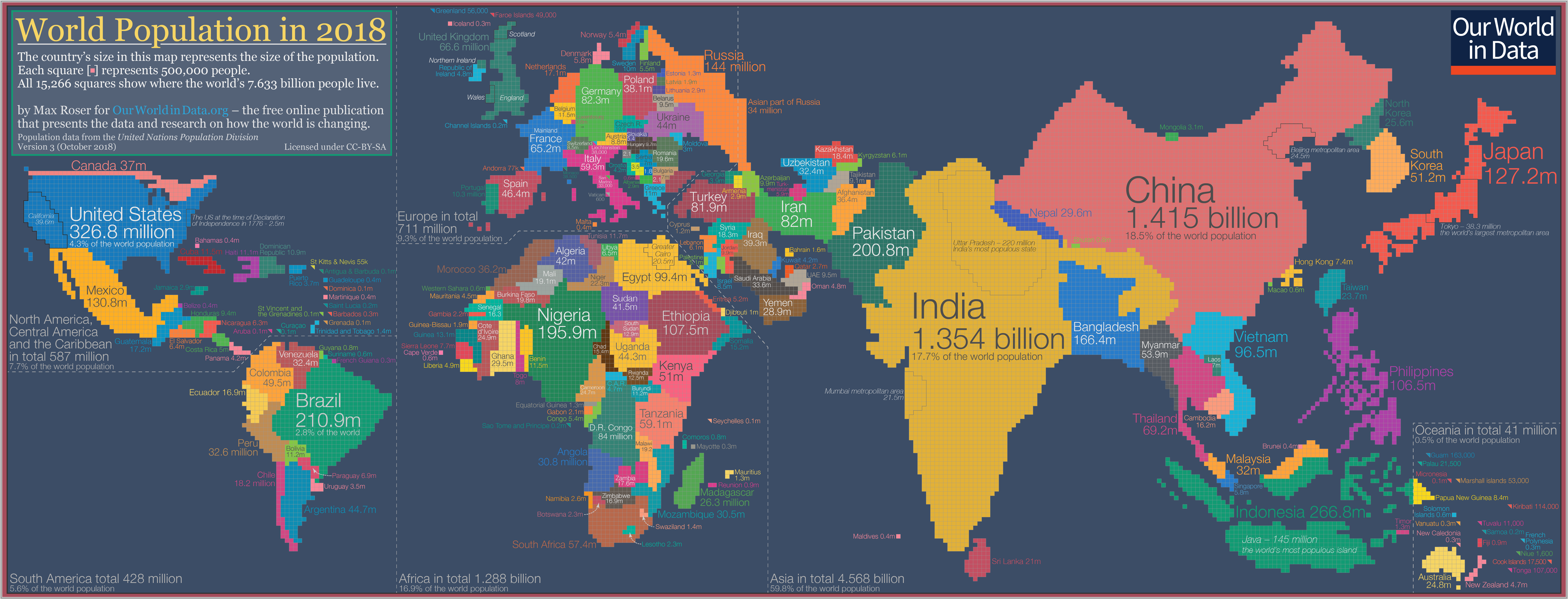
What if the size of the countries depended on their population sizes? Theoretically, this will be how the world will look like:
Source: https://ourworldindata.org/

To download the full-resolution image, you may do so here.

This is what is known as a cartogram. This particular one was made by Our World in Data.

In cartograms, the size of the population is used as scale instead of the land size. This way, one can clearly see how humanity is distributed across countries.

At first glance, this is clearly the world map that we’ve been used to. However, we can observe that some small countries will become humongous and some larger countries will diminish in size if we take into account the population size.

Uncovered insights

Through the cartogram, we can see some obvious observations like China and India being the most populous countries in the world.

If we look closer,  however, we can see relatively smaller countries like Japan and the Philippines depicted as extremely large.

A small country like Bangladesh will be just about the same size as the giant country of Russia if we only talk about population.

Basing from the map, a few number of countries can seemingly engulf the rest when it comes to sheer size. Our World In Data’s figures report that 13 countries in the world, together are home to 4.75 billion people, which is roughly 62% of the world’s population.

  • China (1.415 billion)
  • India (1.354 billion)
  • United States (326.8m)
  • Indonesia (266.8m)
  • Brazil (210.9m)
  • Pakistan (200.8m)
  • Nigeria (195.9m)
  • Bangladesh (166.4m)
  • Russia (144m)
  • Mexico (130.8m)
  •  Japan (127.2m)
  • Ethiopia (107.5m)
  • Philippines (106.5m)

Here is an interactive chart to explore the population growth from different countries:

A change in perspective

If our traditional maps barely have anything to say about the distribution of people in the world, we can expect that it will perform even worse in characterizing the living conditions in countries.

This is where visualizations like cartograms step in. Whenever we read about country statistics, we have to realize that an improvement in one country may be more or less impactful than the other.

For instance, Our World in Data cites life expectancy statistics: an improved life expectancy in Denmark equates to the improvement of the health of 5.8 million. However, an improved life expectancy in India will imply an improved health status of around 1.35 billion people.

Going back to our example of Russia and Nigeria, in spite of their extreme difference in land area, improvements in healthcare in these countries will amount to about the same magnitude of improvement.

The power of visualization

When we think of data analysis, people dealing with figures in order to arrive at estimates and decisions might come to mind.

However, an important instrument in revealing insights from the data is visualization. The human eye is a powerful analytical tool which can reveal things that a large set of numbers and statistical outputs cannot.

This is a sobering reminder for us now that we are receiving massive amounts of data in this digital age. The usefulness of data heavily relies on our ability to extract information and insights from it.

At times, the enormity of data can become burdensome. This rings even truer if we do not know how to handle it.

With this, we must continue to explore ways for data to speak to us. The ever-exploring mind is a crucial ingredient in paving the way towards inclusive policies and equitable reforms that we desire in this age.

Total
0
Shares
Share
Tweet
Share
Share
Related Topics
  • Data
  • Data Visualization
  • Maps
  • Population
dotlah.com

Previous Article
  • Business
  • Cities

Top Tips For Setting Up A Business In A US City

  • January 16, 2020
View Post
Next Article
  • Lah!

Changi Airport Begins Terminal 2 Expansion Works To Increase Capacity And Enhance Passenger Experience

  • January 17, 2020
View Post
You May Also Like
View Post
  • Cities
  • Food

How the Iran war could create a ‘fertiliser shock’ – an often ignored global risk to food prices and farming

  • dotlah.com
  • March 6, 2026
View Post
  • People
  • Working Life

About 23,000 community care sector employees could get at least 7% pay raise as part of new salary guidelines

  • dotlah.com
  • February 18, 2026
View Post
  • Cities
  • Climate Change
  • Science

New research may help scientists predict when a humid heat wave will break

  • dotlah.com
  • January 6, 2026
View Post
  • People
  • Technology

This is what the new frontier of AI-powered financial inclusion looks like

  • dotlah.com
  • January 2, 2026
View Post
  • Cities

How bus stops and bike lanes can make or break your festive city trip

  • dotlah.com
  • December 29, 2025
View Post
  • People
  • Working Life

Skills development is critical to bridging the global digital talent gap

  • dotlah.com
  • December 22, 2025
Points, Lines and a Question
View Post
  • Engineering
  • Op-Ed
  • People

What Is The Point In Making Points?

  • Dean Marc
  • November 27, 2025
View Post
  • Cities
  • People

We must empower local leaders to meet global goals – here’s why

  • dotlah.com
  • November 4, 2025


Trending
  • High school students rising hand up with smile in classroom to answer the question. Lecturer asking questions of students at classroom 1
    • Features
    • People
    A Student’s Guide To Increasing Attention Span
    • February 14, 2022
  • covid-19-lockdown-crossing-street-clay-leconey-Q1qkCeCU6dE-unsplash 2
    • Cities
    Why People Think Suburbs Are Best After Pandemic
    • April 15, 2021
  • MIT MAGE 3
    • Machine Learning
    • Research
    • Science
    • Technology
    Computer Vision System Marries Image Recognition And Generation
    • July 3, 2023
  • 4
    • Science
    GIS, NUS, And Novo Nordisk Team Up To Study Non-alcoholic Fatty Liver Disease In Asian Populations
    • March 12, 2020
  • 5
    • People
    The Rise Of Green-Collar Jobs – And 6 Other Predictions For 2024’s Labour Market
    • January 16, 2024
  • 6
    • Society
    7 Dangerous Myths About Coronavirus Busted By The World Health Organization
    • February 11, 2020
  • 7
    • Technology
    Singles’ Day Shopping: Best Accessories For Students
    • November 7, 2019
  • 8
    • Climate Change
    Why climate summits fail – and three ways to save them
    • October 21, 2025
  • 9
    • Technology
    Tech To The Rescue! Tips For SMEs In the Time Of COVID-19
    • April 26, 2020
  • 10
    • Lah!
    Sunseap Receives S$50 Million Funding From ABC World Asia And Temasek
    • January 31, 2020
  • bench-aaron-burden-2bg1jPty490-unsplash 11
    • Features
    • People
    The 7 Types of Rest You Need to Recharge
    • July 21, 2023
  • 12
    • Cities
    To Help Solve Global Problems, Look To Developing Countries
    • February 29, 2020
Trending
  • Samsung Odyssey 1
    Samsung Showcases Glasses-Free 3D and HDR10+ GAMING With Acclaimed Game Titles at GDC 2026
    • March 9, 2026
  • 2
    How the Iran war could create a ‘fertiliser shock’ – an often ignored global risk to food prices and farming
    • March 6, 2026
  • 3
    About 23,000 community care sector employees could get at least 7% pay raise as part of new salary guidelines
    • February 18, 2026
  • 4
    U.S. Ski & Snowboard and Google Announce Collaboration to Build an AI-Based Athlete Performance Tool
    • February 8, 2026
  • 5
    IBM to Support Missile Defense Agency SHIELD Contract
    • February 5, 2026
  • Smartphone hero image 6
    Zed Approves | Smartphones for Every Budget Range
    • January 29, 2026
  • 7
    Zed Approves | Work From Anywhere, Efficiently – The 2026 Essential Gear Guide
    • January 20, 2026
  • 8
    Global power struggles over the ocean’s finite resources call for creative diplomacy
    • January 17, 2026
  • 9
    New research may help scientists predict when a humid heat wave will break
    • January 6, 2026
  • 10
    This is what the new frontier of AI-powered financial inclusion looks like
    • January 2, 2026
Social Links
dotlah! dotlah!
  • Cities
  • Technology
  • Business
  • Politics
  • Society
  • Science
  • About
Connecting Dots Across Asia's Tech and Urban Landscape

Input your search keywords and press Enter.