dotlah! dotlah!
  • Cities
  • Technology
  • Business
  • Politics
  • Society
  • Science
  • About
Social Links
  • zedreviews.com
  • citi.io
  • aster.cloud
  • liwaiwai.com
  • guzz.co.uk
  • atinatin.com
0 Likes
0 Followers
0 Subscribers
dotlah!
  • Cities
  • Technology
  • Business
  • Politics
  • Society
  • Science
  • About
  • People

Singapore’s national identity excludes those who don’t look like a ‘regular family’

  • October 9, 2025
A couple embraces next to Marina Bay, Singapore, in 2021. Wallace Woon / EPA
Total
0
Shares
0
0
0


A couple embraces next to Marina Bay, Singapore, in 2021.

Pavan Mano, King’s College London

Nationalism usually works on the basis that a nation should imagine itself as a “we”, with a common identity, history and culture. But it doesn’t always clearly say who the “we” are. Instead, it often works by saying who doesn’t belong – frequently by characterising these people in racialised ways.

Singapore is an interesting case study. Since independence in 1965, the small city-state has explicitly committed to a policy of multiracialism and multiculturalism. This principle is enshrined in its constitution, is widely accepted by Singaporeans and has become a firm pillar of national discourse.

Given this commitment, how does nationalism create exclusion in Singapore and what other forms could this take? In my March 2025 book, Straight Nation, I analyse Singapore’s version of a national identity to show how, while avoiding overtly racialised rhetoric and discrimination, it can define belonging in other ways.

Singaporean nationalism excludes some sections of society mainly through maintaining a set of heterosexual familial norms. This is one reason for the book’s title – it calls attention to how straightness sits at the heart of Singaporean identity. A certain kind of straight life is taken to be the model behaviour of a “normal” citizen.

Some of the things one is expected to do include starting a family – by meeting a member of the opposite sex, getting married and having children. This very specific version of heterosexuality is taken as the default in Singapore, and it ends up excluding a whole range of people.

Family and the nation

Heterosexuality being taken as normal and the expectations placed on the nuclear family are not uniquely Singaporean issues. But because of Singapore’s small size, the state has an outsize capacity to influence both how the “normal” Singaporean ought to live and the consequences that follow.

One of the most visible ways people are affected is through the public housing system. Almost 80% of Singaporean residents live in flats built by the country’s public housing authority, the Housing and Development Board (HDB). These flats are so ubiquitous that Singapore’s former prime minister, Lee Hsien Loong, referred to them as “national housing” in 2018.

The catch is that, with some small exceptions, one has to be married to buy a HDB flat. And because same-sex marriage is not recognised in Singapore, heterosexual marriage becomes a condition of access to this national symbol.

This obviously affects LGBTQ+ people, limiting their ability to access public housing and live independently. But the link between heterosexual marriage and public housing affects a whole range of other people. These include single people and parents, those who choose not to get married and people who are divorced.
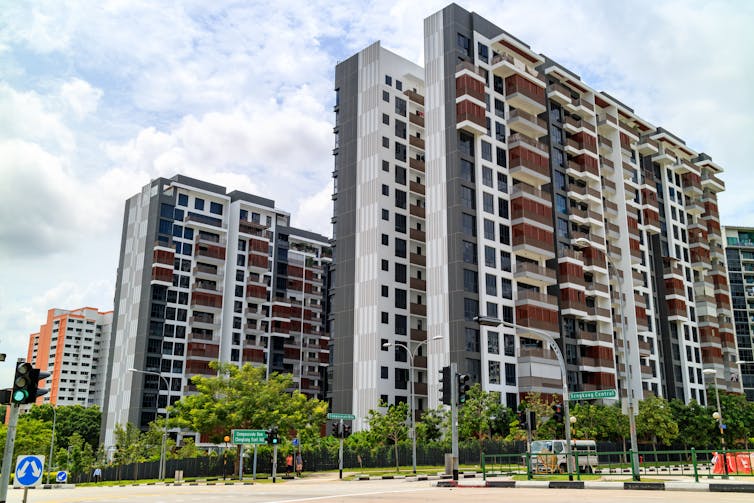
A block of flats in the district of Punggol, Singapore.
Housing Development Board flats in the district of Punggol, Singapore.
happycreator / Shutterstock

There are other examples that demonstrate how it is taken as common sense that one’s life revolves around the nuclear family in Singapore – even though this might not be the case for everyone.

The opening anecdote in Straight Nation shows how the state treats the heterosexual nuclear family as containing the most important set of social relations. Like many other countries at the height of the COVID-19 pandemic, the Singaporean government imposed a lockdown from April to June 2020. When it ended, restrictions were lifted in stages.

Initially, only some in-person interactions were allowed. Singapore’s then-health minister and current deputy prime minister, Gan Kim Yong, said: “Children or grandchildren can visit their parents or grandparents”. He suggested this would “allow families to spend time and provide support to one another” after eight weeks of isolation.

Until the restrictions were further eased 17 days later, visiting one’s parents or grandparents was the only form of in-person social interaction permitted. There was no mention as to what people without a family or estranged from them were meant to do for support. The same applies to people reliant on extended family, such as those who have no have no surviving parents or grandparents, or even those who depend on a close friend.

Again, this assumption can produce exclusions that go beyond sexual difference. To be clear, not everyone will be affected in the same way. But reading Singapore as a straight nation and identifying how one particular kind of heterosexual expression is reified is helpful.

It allows onlookers to ask how these norms can place different kinds of pressure on different people. And perhaps identifying the way in which so many people are affected by this regime of straightness will also help Singapore imagine a future that is fairer and more liveable for everyone.The Conversation

Pavan Mano, Lecturer in Global Cultures, King’s College London

This article is republished from The Conversation under a Creative Commons license. Read the original article ( https://theconversation.com/singapores-national-identity-excludes-those-who-dont-look-like-a-regular-family-259427 ).

Image credits: Wallace Woon / EPA

Total
0
Shares
Share
Tweet
Share
Share
Related Topics
  • Nationalism
  • Singapore
  • Southeast Asia
dotlah.com

Previous Article
Smart Watch
  • Gears

Best Smartwatches, Your Gateway to Health Monitoring and Everyday Use

  • October 5, 2025
View Post
Next Article
  • Gears

Apple introduces the powerful new iPad Pro with the M5 chip

  • October 15, 2025
View Post
You May Also Like
View Post
  • People
  • Working Life

About 23,000 community care sector employees could get at least 7% pay raise as part of new salary guidelines

  • dotlah.com
  • February 18, 2026
View Post
  • People
  • Technology

This is what the new frontier of AI-powered financial inclusion looks like

  • dotlah.com
  • January 2, 2026
View Post
  • People
  • Working Life

Skills development is critical to bridging the global digital talent gap

  • dotlah.com
  • December 22, 2025
Points, Lines and a Question
View Post
  • Engineering
  • Op-Ed
  • People

What Is The Point In Making Points?

  • Dean Marc
  • November 27, 2025
View Post
  • Cities
  • People

We must empower local leaders to meet global goals – here’s why

  • dotlah.com
  • November 4, 2025
View Post
  • People
  • Politics

Singapore PM Wong arrives in Malacañang

  • dotlah.com
  • June 4, 2025
View Post
  • Featured
  • Features
  • People

Conclave: How A New Pope Is Chosen

  • Dean Marc
  • April 25, 2025
View Post
  • People

PM Wong takes Scoot flight, fellow passengers cheer

  • dotlah.com
  • October 16, 2024


Trending
  • 1
    • Cities
    • Lah!
    OCBC Bank, Partnering With Eco-Business, Launches OCBC Climate Index To Measure Environmental Sustainability Awareness And Climate Action In Singapore
    • August 19, 2021
  • desktop-g111779ed1_1280 2
    • Features
    • People
    Fostering Workplace Wellness: Thriving In Remote, Home, & Office Environments
    • May 15, 2023
  • 3
    • Science
    • Technology
    New NUS Research Breakthrough: CircASXL1-1 Regulates BAP1 Deubiquitinase Activity In Leukemia
    • August 14, 2020
  • 4
    • Lah!
    Calling The Young And Young At Heart: First-of-its-kind Play Attractions At Jewel Changi Airport’s Canopy Park Now Open
    • June 10, 2019
  • 5
    • Economy
    • People
    • World Events
    How COVID-19 Is Reversing The Progress In The Fight Against Global Poverty
    • May 29, 2020
  • 6
    • Technology
    DBS Launches New Solutions To Bolster Singaporeans’ Retirement Plans And Financial Resilience Amid Tough Times
    • August 5, 2020
  • 7
    • Climate Change
    This year’s climate talks saw real progress – just not on fossil fuels
    • November 24, 2025
  • 8
    • Gears
    Press Start (Or Hit Enter)! Your Go-To Loadout for Streamers and Gamers.
    • July 19, 2025
  • 9
    • Lah!
    Tuas Nexus – Singapore’s First Integrated Water And Solid Waste Treatment Facility Begins Construction
    • September 9, 2020
  • credit-card-avery-evans-RJQE64NmC_o-unsplash 10
    • People
    7 Reasons You Need A Good Credit Score
    • May 27, 2021
  • 11
    • People
    • World Events
    George Floyd’s Death Reflects The Racist Roots Of American Policing
    • June 3, 2020
  • car-fixing-pexels-photo-2244746 12
    • Cities
    How To Protect Your Cars From Harsh Weather Conditions
    • January 28, 2022
Trending
  • Samsung Odyssey 1
    Samsung Showcases Glasses-Free 3D and HDR10+ GAMING With Acclaimed Game Titles at GDC 2026
    • March 9, 2026
  • 2
    How the Iran war could create a ‘fertiliser shock’ – an often ignored global risk to food prices and farming
    • March 6, 2026
  • 3
    About 23,000 community care sector employees could get at least 7% pay raise as part of new salary guidelines
    • February 18, 2026
  • 4
    U.S. Ski & Snowboard and Google Announce Collaboration to Build an AI-Based Athlete Performance Tool
    • February 8, 2026
  • 5
    IBM to Support Missile Defense Agency SHIELD Contract
    • February 5, 2026
  • Smartphone hero image 6
    Zed Approves | Smartphones for Every Budget Range
    • January 29, 2026
  • 7
    Zed Approves | Work From Anywhere, Efficiently – The 2026 Essential Gear Guide
    • January 20, 2026
  • 8
    Global power struggles over the ocean’s finite resources call for creative diplomacy
    • January 17, 2026
  • 9
    New research may help scientists predict when a humid heat wave will break
    • January 6, 2026
  • 10
    This is what the new frontier of AI-powered financial inclusion looks like
    • January 2, 2026
Social Links
dotlah! dotlah!
  • Cities
  • Technology
  • Business
  • Politics
  • Society
  • Science
  • About
Connecting Dots Across Asia's Tech and Urban Landscape

Input your search keywords and press Enter.