dotlah! dotlah!
  • Cities
  • Technology
  • Business
  • Politics
  • Society
  • Science
  • About
Social Links
  • zedreviews.com
  • citi.io
  • aster.cloud
  • liwaiwai.com
  • guzz.co.uk
  • atinatin.com
0 Likes
0 Followers
0 Subscribers
dotlah!
  • Cities
  • Technology
  • Business
  • Politics
  • Society
  • Science
  • About
  • People
  • World Events

As China Suffers From Coronavirus, Some Wonder: Is It Really That Serious?

  • February 10, 2020
Total
0
Shares
0
0
0

The coronavirus outbreak continues to worsen in China. The Chinese government has announced even stricter measures to stop the spread of the disease, including the rounding up of people in Wuhan, the city where the outbreak began, for mass quarantine. And the doctor who warned authorities about the disease has died. Just how bad might this outbreak become? Virologist and public health expert John A. Lednicky explains.
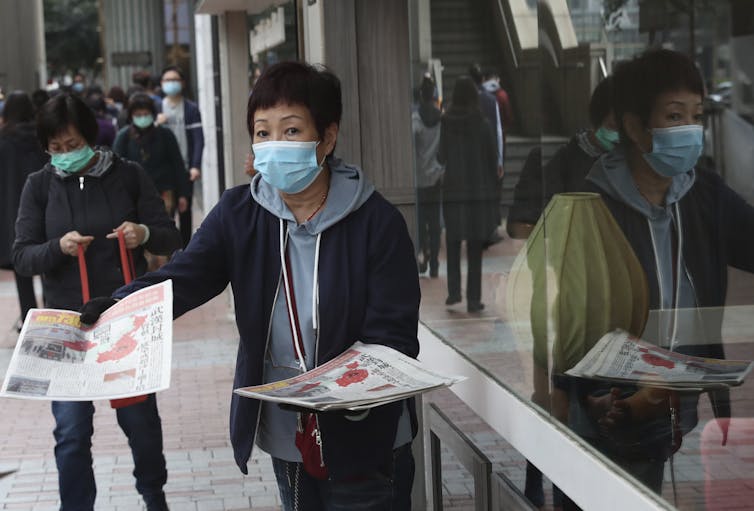
A women wearing a protective face mask delivers a leaflet on coronavirus, in Hong Kong, Friday, Jan 24, 2020. AP Photo.Achmad Ibrahim

1. Is this outbreak really that serious?

Epidemics are spreading more quickly and farther in the 21st century than in previous centuries due to globalization and air travel. When outbreaks occur, there is a predictable pattern that can be summarized as: (a) There is a delay in recognizing that an outbreak is occurring; (b) a significant impact on trade and travel typically occurs due to quarantine measures; (c) the public panics due to misinformation and fear of the unknown, and this can be exacerbated by media coverage.

This outbreak is serious to China, to millions of people there, to its economy and potentially to the world’s economy. China’s main concern is for its own citizens. It has experience controlling outbreaks of different types of influenza viruses, SARS coronavirus, and so on, and the resources to effectively deal with large outbreaks.

China’s government can exert stringent outbreak control measures, such as shutting down public transportation, and take unprecedented moves, such as imposing a citywide quarantine, which would not be easy to do in other countries. Because it is a wealthy country, China is also able to respond to large areas affected by an outbreak, whereas many countries would not be able to afford to do this.

Unlike country-specific responses to outbreaks, the World Health Organization provides guidance on how to control outbreaks worldwide. Its stated primary purpose is to direct international health within the United Nations’ system and to lead partners in global health responses.

The WHO does not have the financial resources to cover all the expenses of a public health response to an epidemic or pandemic. It does provide a limited supply of materials needed for the performance of diagnostic tests to qualified laboratories. The major benefit to the world community is that the WHO releases information regarding the status and severity of an outbreak, and guidance on how to control the outbreak.

The manner in which individual countries respond to outbreaks, whether epidemic or pandemic, is less predictable, especially for those that lack the resources, infrastructure and trained personnel needed for an adequate response.

If the outbreaks are effectively controlled and people remain quarantined for the near-term, the major impacts to the people of China will revolve around issues related to loss of wages, and quality of life issues, such as obtaining sufficient food. If the outbreaks are not controlled, the consequences will be severe. Businesses and school systems will be adversely impacted, and public attitudes toward the government could lead to general discontent and civil disorder.

2. Have there been previous quarantines on this scale?

Small-scale quarantine has been practiced since ancient times, exemplified by the Israelites’ confinement of lepers to specific living areas, onto the present, such as some of the quarantine measures undertaken to control Ebola outbreaks. The quarantine procedures being imposed in China in response to the new coronavirus are unprecedented in scale and complexity. They will be intensively analyzed by scientists and epidemiologists and will inform the next generation of infection control practitioners.

3. Is there an end in sight?

It is too early to predict an end in sight. Many public health specialists are optimistic that the outbreak will burn out as a consequence of stringent infection control and quarantine practices. And as that happens, the hope is that the virus will be eradicated, as was the case for SARS coronavirus. We also hope that the virus does not mutate to a form that is well-adapted to complete its life cycle in humans; that is, that it does not become a common human respiratory virus such as what is thought to have occurred with human coronavirus NL63, a virus that appears to have jumped species from bats to humans.

The Conversation

John A. Lednicky, Research Professor, Environmental and Global Health, University of Florida

This article is republished from The Conversation under a Creative Commons license. Read the original article.


Total
0
Shares
Share
Tweet
Share
Share
Related Topics
  • 2019-nCoV
  • China
  • Coronavirus
  • Quarantine
dotlah.com

Previous Article
  • Cities

MAS Advises Financial Institutions To Adopt Recommended Measures For DORSCON Orange

  • February 9, 2020
View Post
Next Article
  • Cities

Aeroflot To Launch Inaugural Moscow-Singapore Service

  • February 10, 2020
View Post
You May Also Like
Illustration of data storage
View Post
  • Business
  • Featured
  • Features
  • World Events

The Splinternet Comes for European Supply Chains Why Fragmentation Is Now a Boardroom Problem

  • Ackley Wyndam
  • April 21, 2026
totus-technologies-cover
View Post
  • Business
  • Technology
  • World Events

The Transatlantic Tech Rift and Why Data Sovereignty Is the New Industrial Imperative

  • Ackley Wyndam
  • April 16, 2026
View Post
  • People
  • Working Life

About 23,000 community care sector employees could get at least 7% pay raise as part of new salary guidelines

  • dotlah.com
  • February 18, 2026
View Post
  • People
  • Technology

This is what the new frontier of AI-powered financial inclusion looks like

  • dotlah.com
  • January 2, 2026
View Post
  • People
  • Working Life

Skills development is critical to bridging the global digital talent gap

  • dotlah.com
  • December 22, 2025
Points, Lines and a Question
View Post
  • Engineering
  • Op-Ed
  • People

What Is The Point In Making Points?

  • Dean Marc
  • November 27, 2025
View Post
  • Cities
  • People

We must empower local leaders to meet global goals – here’s why

  • dotlah.com
  • November 4, 2025
View Post
  • People

Singapore’s national identity excludes those who don’t look like a ‘regular family’

  • dotlah.com
  • October 9, 2025


Trending
  • 1
    • Technology
    SUTD And Thales Collaborate To Accelerate The Development Of Smart Aviation Technologies
    • February 26, 2020
  • Samsung Odyssey 2
    • Gears
    Samsung Showcases Glasses-Free 3D and HDR10+ GAMING With Acclaimed Game Titles at GDC 2026
    • March 9, 2026
  • 3
    • Lah!
    Digital Time Capsule To Kick Off 30th Anniversary Celebrations At Convocation
    • September 19, 2021
  • 4
    • Lah!
    7 Must-See Christmas Events In Singapore
    • December 23, 2019
  • 5
    • Lah!
    NEA Urges Continued Vigilance As Aedes Aegypti Mosquito Population And Number Of Dengue Cases Remain High At The Start Of 2020
    • January 15, 2020
  • 6
    • Lah!
    • Technology
    ABB To Electrify Autonomous Vehicles For New Port In Singapore
    • October 15, 2019
  • 7
    • Featured
    Paris Unveiled. The Ultimate Guide To Exploring The City Of Light.
    • May 16, 2024
  • covid19-vaccine-pfizer 8
    • Science
    COVID-19 Vaccines: How Pfizer’s And Moderna’s 95% Effective mRNA Shots Work
    • December 14, 2020
  • black-history-month-banner 9
    • People
    Black History Month: What Is It And Why Do We Need It?
    • February 8, 2021
  • Netherlands 10
    • People
    How We Can Identify Climate-Vulnerable Neighbourhoods And Protect Inhabitants
    • January 26, 2024
  • 11
    • People
    Who Came To America, And When?
    • June 15, 2020
  • 12
    • Science
    • Technology
    NUS Researchers Develop New Microsensor Implants For 24/7 Health Monitoring
    • December 27, 2019
Trending
  • Red Hat OpenShift 1
    Red Hat Further Drives Digital Sovereignty for the AI Era with Red Hat OpenShift on Google Cloud Dedicated
    • April 21, 2026
  • Illustration of data storage 2
    The Splinternet Comes for European Supply Chains Why Fragmentation Is Now a Boardroom Problem
    • April 21, 2026
  • 3
    Here’s how to get the $7 trillion AI hardware buildout right
    • April 18, 2026
  • totus-technologies-cover 4
    The Transatlantic Tech Rift and Why Data Sovereignty Is the New Industrial Imperative
    • April 16, 2026
  • 5
    What will it take to get ships going through the Strait of Hormuz again?
    • April 13, 2026
  • 6
    Hon Hai Technology Group (Foxconn) Recognized As Top 100 Global Innovators 2026
    • April 9, 2026
  • 7
    3 lessons on the energy transition in an age of crisis
    • April 7, 2026
  • 8
    Samsung Unveils Galaxy A57 5G and Galaxy A37 5G, Packing Pro-Level Features at Awesome Price
    • March 25, 2026
  • 9
    The global price tag of war in the Middle East
    • March 24, 2026
  • 10
    Kioxia Announces New SSD Model Optimized for AI GPU-Initiated Workloads
    • March 17, 2026
Social Links
dotlah! dotlah!
  • Cities
  • Technology
  • Business
  • Politics
  • Society
  • Science
  • About
Connecting Dots Across Asia's Tech and Urban Landscape

Input your search keywords and press Enter.