dotlah! dotlah!
  • Cities
  • Technology
  • Business
  • Politics
  • Society
  • Science
  • About
Social Links
  • zedreviews.com
  • citi.io
  • aster.cloud
  • liwaiwai.com
  • guzz.co.uk
  • atinatin.com
0 Likes
0 Followers
0 Subscribers
dotlah!
  • Cities
  • Technology
  • Business
  • Politics
  • Society
  • Science
  • About
  • Cities
  • Technology

What The Booms In Electricity And Internet Show About AI

  • October 10, 2023
Total
0
Shares
0
0
0

We would like to thank our generous sponsors for making this article possible.

As investors look to understand how the boom in generative artificial intelligence may play out, lessons from the adoption of electricity and the internet may offer insight into how AI innovation will filter through financial markets, according to Goldman Sachs Research.
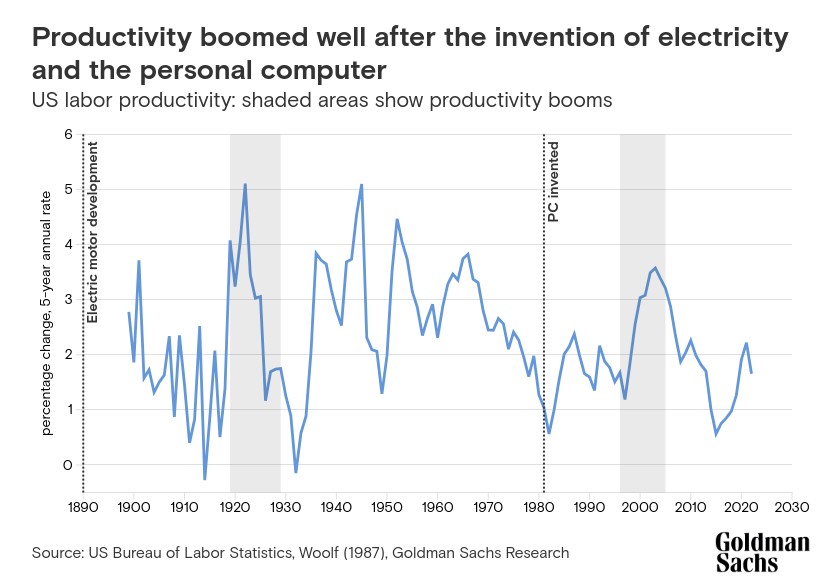
While there are limits to these comparisons — the transition to a peace-time economy following World War I and the emerging market crises in the late 1990s, for example, complicate the analysis — those periods of innovation-driven productivity booms from 1919-1929 and 1996-2005 are most comparable to the AI adoption underway now, Goldman Sachs Research Senior Advisor Dominic Wilson and analyst Vickie Chang write in the team’s report. The later episode allows for a fuller comparison due to data availability and change in financial markets. Over that full episode, U.S. equities had healthy if unspectacular gains, while company profits, earnings, and the S&P 500 outpaced nominal GDP by a modest amount.

Both the Federal Reserve’s policy rate and 10-year Treasury yields were clearly lower in 2005 relative to 1996 and tracked the pattern of the cycle in domestic demand. The U.S. dollar was little changed on net. Oil prices fell sharply during the emerging-market crises in 1997-98 but had risen by 2005.

But within that period, there was a large boom and bust in asset markets as Americans embraced the internet, according to Goldman Sachs Research. “During the initial boom, the pattern of market shifts, though not the magnitudes, match what you would broadly expect to see from an (over-)anticipated productivity boom,” Wilson and Chang write. “Equities rose sharply and valuations climbed to extreme levels.”
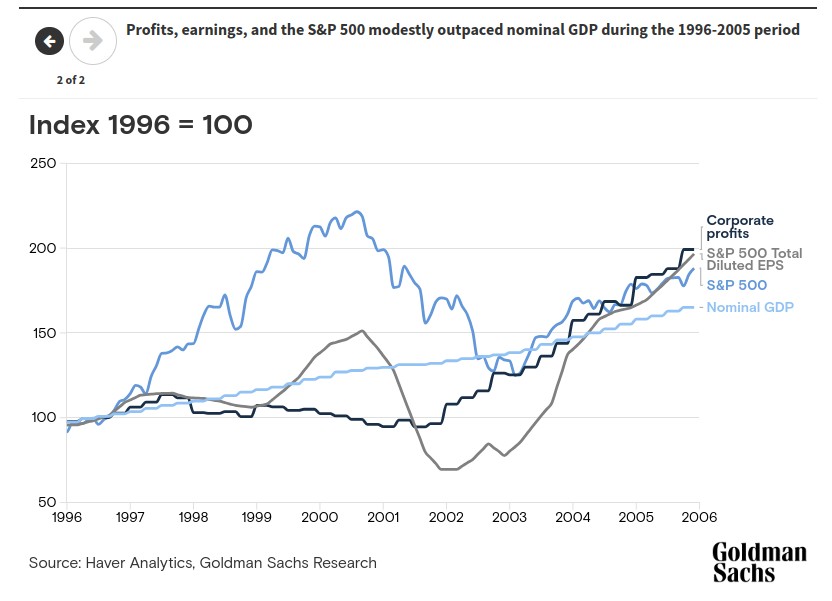
There was also an economic surge. The share of investment climbed, savings rates fell, and the current account deteriorated. Both the fed funds rate and longer-dated yields fell during the 1997-1998 period as the Asian financial crisis and Russia default hit, but with domestic demand booming, the funds rate rose to a fresh cycle peak in 2000. Longer-dated government bond yields rose, too, but remained below their 1996 levels amid low and stable inflation. The bust threw many of those movements into reverse. “Equities saw large declines, interest rates fell, and the bulk of the U.S. dollar strength reversed,” Wilson and Chang write.

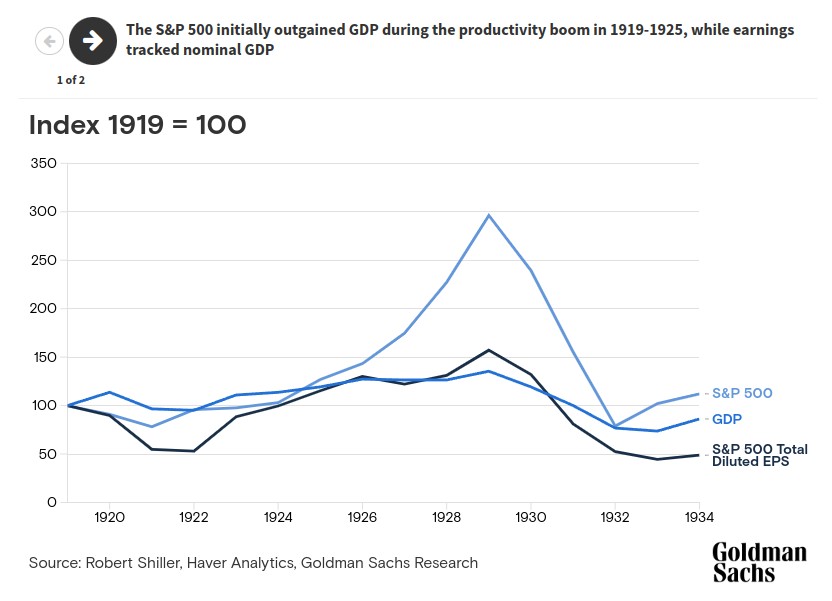
The evidence from the productivity boost in the 1920s as electricity adoption spread is sparser but has some parallel lessons. Equities again had sustained gains alongside the productivity boom. Once again, the equity market rally ended in outsized gains and a very sharp climb in equity valuations, followed by the crash of 1929. The story for Treasury bonds and foreign exchange is harder to map to today’s context given the differences in monetary policy and exchange rate management. Inflation was extremely low over the period. But the Fed’s discount rate again followed the economic and equity cycle, falling in 1924 as the economy weakened before rising steadily and hitting new peaks as the stock bubble accelerated and then burst, Wilson and Chang write.

These episodes suggest that movement in interest rates and currencies was more closely related to the domestic economic cycle than to structural changes in productivity, although the 1990s offer some support for the idea of foreign-exchange appreciation for economies that have outsized gains in productivity. The two prior experiences signal that the biggest impact on asset markets was in equities and equity valuations, and U.S. equities have already been the focus of the potential gains from AI so far.

But historical episodes also indicate there is a risk of a bubble where the market initially overpays for the productivity boom, impacting a broad set of assets. The experience of the 1990s suggests this dynamic could be associated not just with a period of unsustainably high equity prices, but also larger demand booms, greater foreign exchange appreciation, and higher interest rates in the leading AI-adoption countries than would have otherwise been the case.


This article is being provided for educational purposes only. The information contained in this article does not constitute a recommendation from any Goldman Sachs entity to the recipient, and Goldman Sachs is not providing any financial, economic, legal, investment, accounting, or tax advice through this article or to its recipient. Neither Goldman Sachs nor any of its affiliates makes any representation or warranty, express or implied, as to the accuracy or completeness of the statements or any information contained in this article and any liability therefore (including in respect of direct, indirect, or consequential loss or damage) is expressly disclaimed.

Originally published at: Goldman Sachs

Total
0
Shares
Share
Tweet
Share
Share
Related Topics
  • AI
  • Artificial Intelligence
  • Electricity
  • Internet
  • Profit
dotlah.com

Previous Article
  • People

Nobel Peace Prize 2023: Award For Iranian Women’s Rights Protester Highlights Fight Against Declining Democracy Around The World

  • October 8, 2023
View Post
Next Article
  • Cities
  • Technology

New NEOM Progress Film Showcases Rapid Development – Up To October 2023

  • October 11, 2023
View Post
You May Also Like
View Post
  • Artificial Intelligence
  • Technology

How AI can accelerate the energy transition, rather than compete with it

  • dotlah.com
  • November 19, 2025
View Post
  • Cities
  • People

We must empower local leaders to meet global goals – here’s why

  • dotlah.com
  • November 4, 2025
View Post
  • Gears
  • Technology

Apple Vision Pro upgraded with the powerful M5 chip and comfortable Dual Knit Band

  • Dean Marc
  • October 15, 2025
View Post
  • Cities

Politicians love comparing NZ’s economy to Singapore or Ireland – but it’s simplistic and misleading

  • dotlah.com
  • September 21, 2025
View Post
  • Gears
  • Technology

Meet Samsung Galaxy Tab S11 Series: Packing Everything You Expect From a Premium Tablet

  • Dean Marc
  • September 4, 2025
View Post
  • Technology

Malaysia’s ‘ASEAN Shenzhen’ needs some significant legal reform to take off — here’s how

  • dotlah.com
  • August 25, 2025
View Post
  • Gears
  • Technology

Samsung Electronics Debuts Odyssey G7 Monitors, Showcasing Top Games on Its Displays at Gamescom 2025

  • Dean Marc
  • August 20, 2025
View Post
  • Artificial Intelligence
  • Technology

Thoughts on America’s AI Action Plan

  • Dean Marc
  • July 24, 2025


Trending
  • 1
    • Lah!
    • Technology
    Autonomous Vehicle Testbed To Be Expanded To Western Singapore – Continued Emphasis On Public Safety
    • October 24, 2019
  • 2
    • Cities
    • Climate Change
    • People
    • Politics
    The World’s Top Cities Face Stiff Competition, Here’s Why
    • February 6, 2020
  • Atomic energy 3
    • Featured
    • Science
    • Technology
    Nuclear Energy. Super Big Energy Hiding In Super Small Spaces.
    • July 6, 2023
  • goswifties-abba-szOyo9qnlhM-unsplash 4
    • Featured
    Stockholm Sounds: From ABBA’s Waterloo to Taylor’s Eras Tour
    • May 24, 2024
  • Train 5
    • Climate Change
    • People
    Putting People At The Centre Of The Green Transition
    • January 21, 2024
  • hospital-hallway-5979689_1920 6
    • Features
    • People
    Infection Prevention: Latest Trends In Hospital Sanitation
    • November 27, 2021
  • 7
    • Environment
    • People
    Here’s Why The WHO Says A Coronavirus Vaccine Is 18 Months Away
    • February 15, 2020
  • 8
    • Cities
    • Lah!
    Singapore Retains Top Spot Amongst World Maritime Centres For The Eighth Consecutive Year
    • July 13, 2021
  • status-of-global-vaccination-campaigns-24242 9
    • People
    • World Events
    These Countries Have Yet To Start Covid-19 Vaccinations
    • February 22, 2021
  • 10
    • Technology
    Made By Google 2019: Here Are Google’s Biggest Product Announcements
    • October 16, 2019
  • 11
    • Technology
    8 Easy Ways To Protect Your Online Privacy
    • November 1, 2018
  • new-york-bernd-dittrich-YzWyaN4OBNA-unsplash 12
    • Cities
    The World’s Most Expensive Cities
    • December 28, 2022
Trending
  • zedreviews-12-gaming-holiday-deals-202512 1
    Zed Approves | 12 Gaming Upgrades You Actually Need This Holiday Season
    • December 17, 2025
  • zedreviews-amazon-uk-50-christmas-deals 2
    Zed Approves | The Amazon 50+ Holiday Gift Deals Worth Buying – UK Edition
    • December 14, 2025
  • Watches 3
    Zed Approves | 12 Watch Gifts for the Holiday Season
    • December 14, 2025
  • 6 Bags You Might Be Missing for Your Next Trip 4
    Zed Approves | 6 Bags You Might Be Missing for Your Next Trip
    • December 2, 2025
  • Zed Approves | 48 Highly Rated Black Friday Deals in 2025 5
    Zed Approves | 48 Highly Rated Black Friday Deals in 2025
    • November 28, 2025
  • Points, Lines and a Question 6
    What Is The Point In Making Points?
    • November 27, 2025
  • 7
    This year’s climate talks saw real progress – just not on fossil fuels
    • November 24, 2025
  • Early Black Friday Deals - Hero image 8
    Zed Approves | More Early Black Friday 2025 Deals You Can’t Miss
    • November 22, 2025
  • 9
    How AI can accelerate the energy transition, rather than compete with it
    • November 19, 2025
  • 10
    Five key issues at the UN climate summit in Brazil – and why they matter to you and the planet
    • November 15, 2025
Social Links
dotlah! dotlah!
  • Cities
  • Technology
  • Business
  • Politics
  • Society
  • Science
  • About
Connecting Dots Across Asia's Tech and Urban Landscape

Input your search keywords and press Enter.