dotlah! dotlah!
  • Cities
  • Technology
  • Business
  • Politics
  • Society
  • Science
  • About
Social Links
  • zedreviews.com
  • citi.io
  • aster.cloud
  • liwaiwai.com
  • guzz.co.uk
  • atinatin.com
0 Likes
0 Followers
0 Subscribers
dotlah!
  • Cities
  • Technology
  • Business
  • Politics
  • Society
  • Science
  • About
  • Cities

How 18 Million Americans Could Move Into Rural Areas – Without Leaving Home

  • March 11, 2021
sunset-hill-seattle-evan-tahler-odMN4BZzDSo-unsplash
Total
0
Shares
0
0
0

About 46 million Americans – 14% of the nation’s inhabitants – are currently classified as living in rural areas. That number could jump to 64 million – an increase of nearly 40% – without anyone moving into a new home. That could actually hurt small cities and rural communities across the country.

The federal government classifies communities’ characteristics based on their populations, according to a definition created by the federal Office of Management and Budget. The criteria haven’t substantially changed since the 1940s. Since then, the U.S. population has more than doubled, from 152 million in 1950 to more than 328 million in 2019.
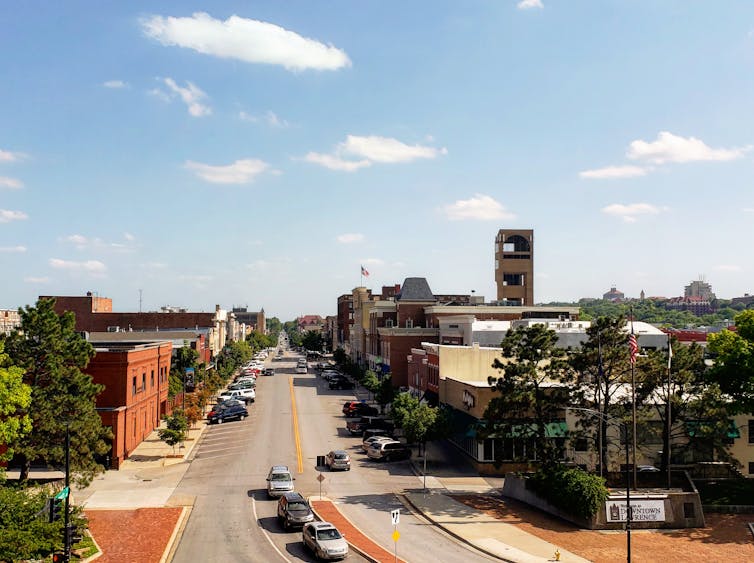
Lawrence, Kan., is one of the communities that would go from being considered urban to rural.
Ian Ballinger via Wikimedia Commons, CC BY-SA

The main dividing line is between communities – which include both towns and cities and their surrounding counties – with more than 50,000 people and those with fewer than that number. Over the past 70 years, the number of areas with at least that many people has increased from 168 to 384 as small towns have grown into small cities. For example, from 1950 to 2010, the population of Lawrence, Kansas, grew from 23,351 to 87,643.

Under the current definition, Colbert County, Alabama – population 54,428 – is in the same category as Los Angeles County – population over 10 million. As the Trump administration ended, federal officials decided some more nuance would be useful in understanding American communities. They proposed to change the dividing line to populations of more than 100,000 – and the effort appears to be continuing under the Biden administration.

That change would effectively move everyone who lives in places with 50,000 to 100,000 from urban to rural life, because their cities, including San Luis Obispo, California, and Battle Creek, Michigan, will no longer be considered large enough to count as metropolitan.

Redefining rural

The government doesn’t specifically use this system to label places as “urban” or “rural.” Instead, there are three government categories – “metropolitan,” “micropolitan” and “outside a core based statistical area.” However, most government agencies, researchers, advocates and media outlets use these classifications to sort communities into two groups – equating “metropolitan” with “urban” and the other two categories together as “rural.”

Making the proposed change would mean 144 areas with populations between 50,000 and 100,000, and the 251 counties they occupy, would no longer be classified as “metropolitan,” but rather as “micropolitan” – and therefore effectively rural – including Flagstaff, Arizona, and Blacksburg, Virginia. The change would leave Wyoming without any metropolitan areas at all.

The Office of Management and Budget is accepting comments about this proposed change until March 19.

Looking at the numbers

Changing how rural areas are defined could change Americans’ understanding of rural life.

For instance, the current data reveal that rural areas have less access to broadband internet and health care services.

But if the homes and communities of 18 million more Americans are added to those rural statistics, the numbers could look better. That rosier picture – which would not be the result of any actual changes to Americans’ lives – could reduce public and political pressure to improve life in rural communities.

It’s also not clear whether 100,000 is the right boundary for urban living – or of there is an exact number at all. To people in major cities, a community of 80,000 like Santa Fe, New Mexico, may be more similar to the 22,000-person Roseburg, Oregon, than to Chicago or Miami. To a rancher on the Plains, with fewer than one person per square mile, though, Santa Fe may qualify as a “big city,” with chain stores, hospitals and government offices.

More than a statistical shift

Though the government’s proposal says it’s meant as a statistical change only, the classifications are commonly used by government agencies, charities and other organizations to determine which communities are eligible for their funding or programs.

The change could make many small American cities, which would be newly identified as rural, ineligible for money to help community planning and public transit – even if they currently get that money.

Communities currently designated as rural may be hurt, too. If Congress and states don’t allocate more funds to serve the increased number of people classified as living in rural areas, the money that is available – like rural health grants – would be spread more thinly.


Devon Brenner, Assistant VP for Outreach and Initiatives, Office of Research and Economic Development, and Professor, College of Education, Mississippi State University and Jesse Longhurst, Assistant Professor of Education, Southern Oregon University

This article is republished from The Conversation under a Creative Commons license. Read the original article.

Total
0
Shares
Share
Tweet
Share
Share
Related Topics
  • America
  • Rural
  • Urban
  • USA
majulah

Previous Article
  • Cities
  • Lah!

Singapore Airlines First In World To Pilot IATA’s Travel Pass App

  • March 10, 2021
View Post
Next Article
  • Lah!
  • Technology

Sustainable Urban Farming – Lighting Up Our Local Farms

  • March 12, 2021
View Post
You May Also Like
View Post
  • Cities
  • Climate Change
  • Science

New research may help scientists predict when a humid heat wave will break

  • dotlah.com
  • January 6, 2026
View Post
  • Cities

How bus stops and bike lanes can make or break your festive city trip

  • dotlah.com
  • December 29, 2025
View Post
  • Cities
  • People

We must empower local leaders to meet global goals – here’s why

  • dotlah.com
  • November 4, 2025
View Post
  • Cities

Politicians love comparing NZ’s economy to Singapore or Ireland – but it’s simplistic and misleading

  • dotlah.com
  • September 21, 2025
View Post
  • Cities
  • Technology

Meralco PowerGen’s PacificLight starts up 100 MW fast-response plant in Singapore

  • dotlah.com
  • June 20, 2025
View Post
  • Cities

Renewable energy, carbon credits are priority areas of cooperation for Singapore, Philippines: Lawrence Wong

  • dotlah.com
  • June 4, 2025
View Post
  • Cities
  • Politics

Singapore businesses eye more investments in PH, says PM Wong

  • Dean Marc
  • June 4, 2025
View Post
  • Cities
  • Research

Mathematicians uncover the logic behind how people walk in crowds

  • dotlah.com
  • April 3, 2025


Trending
  • 1
    • Cities
    • Lah!
    NParks Implements More Nature-Based Solutions To Protect And Restore Singapore’s Coasts
    • September 28, 2021
  • 2
    • Technology
    Sembcorp To Build 8.2 Megawatt-Peak Solar Power Energy System On Singapore Airlines And SIA Engineering Company’s Properties
    • February 13, 2020
  • 3
    • Science
    Why Newton’s ‘law of universal gravitation’ is not so universal after all
    • October 7, 2019
  • 4
    • Lah!
    • Technology
    Uncovering The Rise And Challenges Of Singapore Deep Tech Startups
    • February 4, 2021
  • where-american-city-dwellers-lack-access-to-running-water-23731 5
    • Cities
    Where American City-Dwellers Lack Access To Running Water
    • December 10, 2020
  • 6
    • Cities
    SGX RegCo Expands Range Of Enforcement Powers
    • June 25, 2021
  • average-change-in-us-urban-congestion-levels-23926 7
    • Cities
    How Covid-19 Affected America’s Rush Hour In 2020
    • January 18, 2021
  • 8
    • Technology
    ST Engineering Partners SUTD To Advance Continuous Learning In Design Thinking
    • January 20, 2020
  • women-hannah-busing-Zyx1bK9mqmA-unsplash 9
    • People
    • World Events
    Only Twelve Countries Have Full Equal Rights for Women
    • March 8, 2022
  • 10
    • Society
    What We Know Suggests The Economic Impact Of Wuhan Coronavirus Will Be Limited
    • January 28, 2020
  • 11
    • Cities
    • Lah!
    LTA To Deploy Electric Buses From Early 2020
    • November 11, 2019
  • 12
    • Cities
    LTA Awards Four Jurong Region Line Contracts
    • July 21, 2020
Trending
  • 1
    Zed Approves | Work From Anywhere, Efficiently – The 2026 Essential Gear Guide
    • January 20, 2026
  • 2
    Global power struggles over the ocean’s finite resources call for creative diplomacy
    • January 17, 2026
  • 3
    New research may help scientists predict when a humid heat wave will break
    • January 6, 2026
  • 4
    This is what the new frontier of AI-powered financial inclusion looks like
    • January 2, 2026
  • 5
    How bus stops and bike lanes can make or break your festive city trip
    • December 29, 2025
  • 6
    Skills development is critical to bridging the global digital talent gap
    • December 22, 2025
  • Tech Not To Miss 7
    Zed Approves | 12 Cool Tech You’ll Regret Missing
    • December 21, 2025
  • zedreviews-12-gaming-holiday-deals-202512 8
    Zed Approves | 12 Gaming Upgrades You Actually Need This Holiday Season
    • December 17, 2025
  • zedreviews-amazon-uk-50-christmas-deals 9
    Zed Approves | The Amazon 50+ Holiday Gift Deals Worth Buying – UK Edition
    • December 14, 2025
  • Watches 10
    Zed Approves | 12 Watch Gifts for the Holiday Season
    • December 14, 2025
Social Links
dotlah! dotlah!
  • Cities
  • Technology
  • Business
  • Politics
  • Society
  • Science
  • About
Connecting Dots Across Asia's Tech and Urban Landscape

Input your search keywords and press Enter.