dotlah! dotlah!
  • Cities
  • Technology
  • Business
  • Politics
  • Society
  • Science
  • About
Social Links
  • zedreviews.com
  • citi.io
  • aster.cloud
  • liwaiwai.com
  • guzz.co.uk
  • atinatin.com
0 Likes
0 Followers
0 Subscribers
dotlah!
  • Cities
  • Technology
  • Business
  • Politics
  • Society
  • Science
  • About
  • Cities
  • Society

Here Are The Cleanest And Most Corrupt Governments Of The World

  • February 4, 2020
Total
0
Shares
0
0
0

Denmark and New Zealand are the least corrupt countries in the world while Somalia is the most corrupt. This is based on the 2019 results of the Corruption Perceptions Index (CPI), an annual study by Transparency International.
Highlights

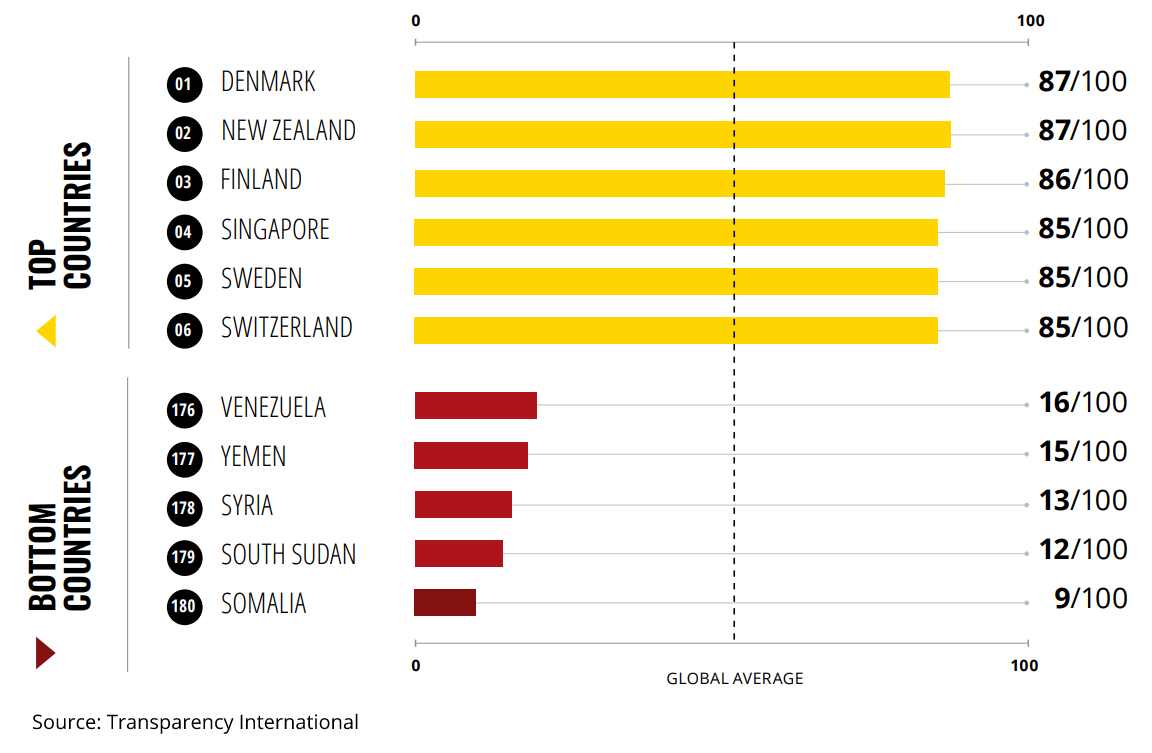
For this year’s edition, 180 countries were included in the study. Among these countries,  Denmark and New Zealand attained the highest CPI score of 87, meaning they are deemed to be clean governments. This is followed by Finland (86). Finland is followed by Singapore, Sweden, and Switzerland in a triple tie (85).

On the opposite extreme, Somalia scored the lowest CPI at only 9 out of 100. Other low scorers are South Sudan (12), Syria (13), Yemen (15), and Venezuela (16).

The global average is at 43, with two-thirds of the countries included in the study gaining CPI scores that are below 50.

The Western Europe & European Union is the region with the highest average score at 66. Meanwhile, the Sub-saharan Africa recorded the lowest average CPI at 32. Last year, these regions were also the best and the worst, respectively.

Measuring corruption

In order to come up with the CPI, Transparency International aggregates from 13 data sources collected by 12 trusted institutions. The data points are the perceptions of businessmen and country expects with regards to the level of corruption of a particular country’s public sector.

The collected information from these sources are mathematically standardized to attain the same scale. Afterwards, the scores of a country are averaged. This average score is a country’s CPI value.

CPI is a measure of corruption that ranges from 0 to 100, with a 0 indicating that a country is highly corrupt and 100 indicating that a country’s public sector is very clean.

In order to be included in the study, at least three data sources must have assessed a country, otherwise, they are dropped.

Ending corruption

Even in the top countries, corruption remains to be a problem that needs to be battled. With this, Transparency International gave some recommendations to put an end to corruption and to restore trust in the public sector.

  1. Manage conflicts of interest, by tightening the control of the government in its areas of interest such as finance
  2. Control political financing, by properly enforcing campaign finance regulations
  3. Strengthen electoral integrity,  by ensuring fair elections
  4. Regulate lobbying activities, by making them more accessible to the public
  5. Tackle preferential treatment, by making sure that service delivery and resource allocation are not driven by misaligned interests
  6. Empower citizens, by protecting their civil liberties and political rights
  7. Reinforce checks and balances, by the promotion of the separation of powers and judicial independence.

“Governments must urgently address the corrupting role of big money in political party financing and the undue influence it exerts on our political systems,” Transparency International Chair Delia Ferreira Rubio noted.

To finally end corruption, there is a need for genuine public servants who are willing to cut the opportunities for corruption and to strengthen existing political frameworks.

This is, of course, a highly idealistic notion that is easier said than done, especially given the existence of governments whose interest is only to serve themselves.

Hopefully, our desire to have a clean and equitable public sector is not too absurd a proposition that in the end will be reduced to nothing but wishful thinking.

Total
0
Shares
Share
Tweet
Share
Share
Related Topics
  • Corruption
  • Corruption Perceptions Index
  • Government
  • Least Corrupt Government
  • Politics
  • Transparency International
majulah

Previous Article
  • Lah!

Remembering The War Through Battle For Singapore

  • February 4, 2020
View Post
Next Article
  • Society

The Simple Reason Why We Are Seeing More New Infectious Diseases Today

  • February 4, 2020
View Post
You May Also Like
View Post
  • Cities
  • Economy
  • Politics

The global price tag of war in the Middle East

  • dotlah.com
  • March 24, 2026
View Post
  • Cities
  • Food

How the Iran war could create a ‘fertiliser shock’ – an often ignored global risk to food prices and farming

  • dotlah.com
  • March 6, 2026
View Post
  • Cities
  • Climate Change
  • Science

New research may help scientists predict when a humid heat wave will break

  • dotlah.com
  • January 6, 2026
View Post
  • Cities

How bus stops and bike lanes can make or break your festive city trip

  • dotlah.com
  • December 29, 2025
View Post
  • Cities
  • People

We must empower local leaders to meet global goals – here’s why

  • dotlah.com
  • November 4, 2025
View Post
  • Cities

Politicians love comparing NZ’s economy to Singapore or Ireland – but it’s simplistic and misleading

  • dotlah.com
  • September 21, 2025
View Post
  • Cities
  • Technology

Meralco PowerGen’s PacificLight starts up 100 MW fast-response plant in Singapore

  • dotlah.com
  • June 20, 2025
View Post
  • Cities

Renewable energy, carbon credits are priority areas of cooperation for Singapore, Philippines: Lawrence Wong

  • dotlah.com
  • June 4, 2025


Trending
  • 1
    • Cities
    • Society
    COVID-19: This Is How Asia-Pacific Is Emerging From Lockdown
    • May 8, 2020
  • 2
    • Science
    • Technology
    How Urban Farming Tech Is Shaping The Future Of Food
    • September 3, 2020
  • 3
    • Lah!
    • Technology
    Singapore To Advance COVID-19 Research Collaboration With ASEAN And Strengthen Regional Capabilities To Combat Pandemics
    • June 18, 2021
  • 4
    • Cities
    The 4 Plausible Futures Of The World: Greentocracy
    • March 19, 2020
  • 5
    • Lah!
    Asian Cities To Experience Hotter & Drier Climate — Yes, Including Singapore
    • August 18, 2019
  • 6
    • Cities
    • World Events
    COVID-19: Which Economies Are Reopening
    • June 8, 2020
  • 7
    • Lah!
    Plans To Fight Coronavirus Must Pay Attention To The Environment
    • February 29, 2020
  • 8
    • Lah!
    CapitaLand Investment Makes Debut On The Singapore Exchange As One Of The World’s Largest Listed Real Estate Investment Managers
    • September 22, 2021
  • sunset-hill-seattle-evan-tahler-odMN4BZzDSo-unsplash 9
    • Cities
    How 18 Million Americans Could Move Into Rural Areas – Without Leaving Home
    • March 11, 2021
  • 10
    • Cities
    Total solar eclipses provide an opportunity to engage with science, culture and history
    • March 19, 2024
  • 11
    • Cities
    How Cities Around The World Are Handling COVID-19 – And Why We Need To Measure Their Preparedness
    • March 18, 2020
  • 12
    • Lah!
    Why Can’t You Divide By Zero?
    • April 9, 2018
Trending
  • 1
    Here’s how to get the $7 trillion AI hardware buildout right
    • April 18, 2026
  • totus-technologies-cover 2
    The Transatlantic Tech Rift and Why Data Sovereignty Is the New Industrial Imperative
    • April 16, 2026
  • 3
    What will it take to get ships going through the Strait of Hormuz again?
    • April 13, 2026
  • 4
    Hon Hai Technology Group (Foxconn) Recognized As Top 100 Global Innovators 2026
    • April 9, 2026
  • 5
    3 lessons on the energy transition in an age of crisis
    • April 7, 2026
  • 6
    Samsung Unveils Galaxy A57 5G and Galaxy A37 5G, Packing Pro-Level Features at Awesome Price
    • March 25, 2026
  • 7
    The global price tag of war in the Middle East
    • March 24, 2026
  • 8
    Kioxia Announces New SSD Model Optimized for AI GPU-Initiated Workloads
    • March 17, 2026
  • Samsung Odyssey 9
    Samsung Showcases Glasses-Free 3D and HDR10+ GAMING With Acclaimed Game Titles at GDC 2026
    • March 9, 2026
  • 10
    How the Iran war could create a ‘fertiliser shock’ – an often ignored global risk to food prices and farming
    • March 6, 2026
Social Links
dotlah! dotlah!
  • Cities
  • Technology
  • Business
  • Politics
  • Society
  • Science
  • About
Connecting Dots Across Asia's Tech and Urban Landscape

Input your search keywords and press Enter.