dotlah! dotlah!
  • Cities
  • Technology
  • Business
  • Politics
  • Society
  • Science
  • About
Social Links
  • zedreviews.com
  • citi.io
  • aster.cloud
  • liwaiwai.com
  • guzz.co.uk
  • atinatin.com
0 Likes
0 Followers
0 Subscribers
dotlah!
  • Cities
  • Technology
  • Business
  • Politics
  • Society
  • Science
  • About
  • Climate Change
  • People

AI Meets Climate: MIT Energy And Climate Hack 2023

  • December 18, 2023
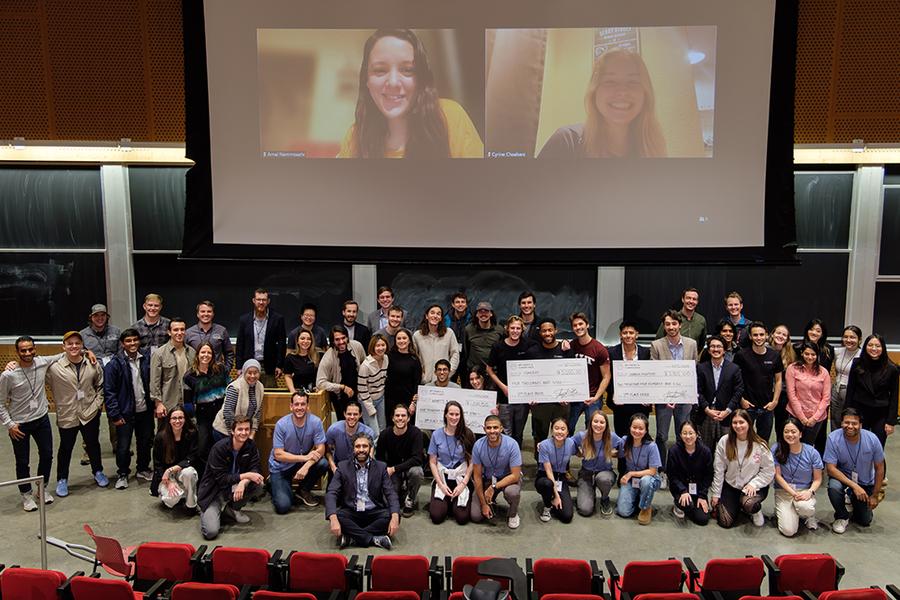
Event participants, in person and virtually, gather for a photo. Credits:Photo courtesy of MIT Hackathon 2023.
Total
0
Shares
0
0
0

The Energy and Climate Hack presented opportunities for students and companies to collaborate and develop innovative solutions.

Johnathon Horn | Division of Student Life
MIT News (https://news.mit.edu/2023/ai-meets-climate-mit-energy-climate-hack-1214)

Event participants, in person and virtually, gather for a photo. Credits:Photo courtesy of MIT Hackathon 2023.

The MIT Energy and Climate Hack brought together participants from myriad fields and disciplines to develop rapid, innovative solutions to one of the most complex challenges facing society today: the global energy and climate crisis. Hundreds of students from MIT and colleges across the globe convened on MIT’s campus and virtually for this year’s event, which was held Nov. 10-12.

Established in 2013, the MIT Energy and Climate Hack has been the launchpad for innovative and sustainable solutions for a decade; an annual reminder that exciting new ideas are always just around the corner.

According to Claire Lorenzo, an MIT student organizer and communications director for this year’s Energy and Climate Hack, “There were a lot of people from a lot of places who showed up; both virtually and in person. It was encouraging to see how driven everyone was. How passionate they were about finding great solutions. You could see these ideas starting to form immediately.”

On the first day, representatives from companies across numerous industries presented participants with their most pressing energy and climate-related challenges. Once the gathering broke into teams, participants had two days to “hack the challenge” they were assigned and present their solution to company representatives, fellow hackers, and judges.  

The focus areas at this year’s event were energy markets, transportation, and farms and forests. Participating corporate sponsors included Google, Crusoe, Ironwood, Foothill Ventures, Koidra, Mitra Chem, Avangrid, Schneider Electric, First Solar, and Climate Ledger. 

This year’s event also marked the first time that artificial intelligence emerged as a viable tool for developing creative climate solutions. Lorenzo observed, “I’m studying computer science, so exploring how AI could be harnessed to have a positive impact on the climate was particularly exciting for me. It can be applicable to virtually any domain. Like transportation, [with emissions] for example. In agriculture, too.”

Energy and Climate Hack organizers identified the implementation of four core AI applications for special consideration: the acceleration of discovery (shortening the development process while simultaneously producing less waste), optimizing real-world solutions (utilizing automation to increase efficiency), prediction (using AI to improve prediction algorithms), and processing unstructured data (using AI to analyze and scale large amounts of data efficiently).

“If there was a shared sentiment among the participants, it would probably be the idea that there isn’t a singular solution to climate change,” says Lorenzo, “and that requires cooperation from various industries, leveraging knowledge and experience from numerous fields, to make a lasting impact.”

After the initial round of presentations concluded, one team from each challenge advanced from the preliminary presentation judging session to the final presentation round, where they pitched their solutions to a crowded room of attendees. Once the semi-finalists had pitched their solutions, the judges deliberated over the entries and selected team Fenergy, which worked in the energy markets sector, as the winners. The team, consisting of Alessandro Fumi, Amal Nammouchi, Amaury De Bock, Cyrine Chaabani, and Robbie Lee V, said, “Our solution, Unbiased Cathode, enables researchers to assess the supply chain implications of battery materials before development begins, hence reducing the lab-to-production timeline.”

“They created a LLM [large language model]-powered tool that allows innovative new battery technologies to be iterated and developed much more efficiently,” Lorenzo added.

When asked what she will remember most about her first experience at the MIT Energy and Climate Hack, Lorenzo replied, “Having hope for the future. Hope from seeing the passion that so many people have to find a solution. Hope from seeing all of these individuals come so far to tackle this challenge and make a difference. If we continue to develop and implement solutions like these on a global level, I am hopeful.”

Students interested in learning more about the MIT Energy and Climate Hackathon, or participating in next year’s Hack, can find more information on the event website.

Reprinted with permission of MIT News (http://news.mit.edu/)
Total
0
Shares
Share
Tweet
Share
Share
Related Topics
  • AI
  • Artificial Intelligence
  • Education
  • Energy
  • Hackathon
  • MIT Energy and Climate Hack
  • Sustainability
dotlah.com

Previous Article
  • Artificial Intelligence
  • People

AI Meets Climate: MIT Energy And Climate Hack 2023

  • December 18, 2023
View Post
Next Article
  • Cities
  • Climate Change

Why The COP28 Climate Summit Mattered, And What To Watch For In 2024

  • December 27, 2023
View Post
You May Also Like
View Post
  • People
  • Working Life

About 23,000 community care sector employees could get at least 7% pay raise as part of new salary guidelines

  • dotlah.com
  • February 18, 2026
View Post
  • Cities
  • Climate Change
  • Science

New research may help scientists predict when a humid heat wave will break

  • dotlah.com
  • January 6, 2026
View Post
  • People
  • Technology

This is what the new frontier of AI-powered financial inclusion looks like

  • dotlah.com
  • January 2, 2026
View Post
  • People
  • Working Life

Skills development is critical to bridging the global digital talent gap

  • dotlah.com
  • December 22, 2025
Points, Lines and a Question
View Post
  • Engineering
  • Op-Ed
  • People

What Is The Point In Making Points?

  • Dean Marc
  • November 27, 2025
View Post
  • Climate Change

This year’s climate talks saw real progress – just not on fossil fuels

  • dotlah.com
  • November 24, 2025
View Post
  • Climate Change

Five key issues at the UN climate summit in Brazil – and why they matter to you and the planet

  • dotlah.com
  • November 15, 2025
View Post
  • Cities
  • People

We must empower local leaders to meet global goals – here’s why

  • dotlah.com
  • November 4, 2025


Trending
  • 1
    • Cities
    COVID-19 Has Created More Cyclists: How Cities Can Keep Them On Their Bikes
    • August 4, 2020
  • singapore-carbon-market-alliance 2
    • Economy
    • Environment
    Launch of Singapore Carbon Market Alliance (SCMA) to enable access to and supply of high-quality carbon credits
    • August 1, 2024
  • 3
    • Lah!
    • Technology
    Apple’s Second Singapore Store To Open In July At Jewel Changi Airport
    • July 11, 2019
  • Eyeglass | Computer | Learning 4
    • Artificial Intelligence
    • People
    • Technology
    6 Ways AI Can Make Political Campaigns More Deceptive Than Ever
    • July 26, 2023
  • 5
    • Lah!
    New Global Alliance For Unified Programming Standards For Smart Ports
    • October 23, 2020
  • 6
    • Technology
    SGInnovate Launches Deep Tech For Good Initiative
    • July 4, 2020
  • gcs-how-the-world-commutes-25129 7
    • Cities
    How the World Commutes
    • June 22, 2021
  • 8
    • People
    Here Are 6 Lessons Social Entrepreneurs Learned About Creating Systems Change
    • January 25, 2020
  • 9
    • Artificial Intelligence
    • Technology
    Deep dive into AI with Google Cloud’s global generative AI roadshow
    • February 18, 2025
  • 10
    • Lah!
    Singapore Re-Elected To The Council Of The International Civil Aviation Organization
    • October 1, 2019
  • usa-reasons-for-not-buying-an-electric-vehicle-27974 11
    • Cities
    • Environment
    High Prices, Range Anxiety Holding Back EV Adoption
    • August 12, 2022
  • 12
    • Lah!
    Building Resilience In A Post-COVID World
    • September 8, 2020
Trending
  • Samsung Odyssey 1
    Samsung Showcases Glasses-Free 3D and HDR10+ GAMING With Acclaimed Game Titles at GDC 2026
    • March 9, 2026
  • 2
    How the Iran war could create a ‘fertiliser shock’ – an often ignored global risk to food prices and farming
    • March 6, 2026
  • 3
    About 23,000 community care sector employees could get at least 7% pay raise as part of new salary guidelines
    • February 18, 2026
  • 4
    U.S. Ski & Snowboard and Google Announce Collaboration to Build an AI-Based Athlete Performance Tool
    • February 8, 2026
  • 5
    IBM to Support Missile Defense Agency SHIELD Contract
    • February 5, 2026
  • Smartphone hero image 6
    Zed Approves | Smartphones for Every Budget Range
    • January 29, 2026
  • 7
    Zed Approves | Work From Anywhere, Efficiently – The 2026 Essential Gear Guide
    • January 20, 2026
  • 8
    Global power struggles over the ocean’s finite resources call for creative diplomacy
    • January 17, 2026
  • 9
    New research may help scientists predict when a humid heat wave will break
    • January 6, 2026
  • 10
    This is what the new frontier of AI-powered financial inclusion looks like
    • January 2, 2026
Social Links
dotlah! dotlah!
  • Cities
  • Technology
  • Business
  • Politics
  • Society
  • Science
  • About
Connecting Dots Across Asia's Tech and Urban Landscape

Input your search keywords and press Enter.